ID Society
Director (Production & Multimedia), managing accounts including Crown Royal Whisky, and developing rich media and interactive marketing campaigns for clients including Disney and AMC.
Born in Summit, N.J., David grew up mainly in Australia, and was educated at Melbourne University. During an extended and unfinished Law/Computer Science (combined) degree he was elected co-editor of the student newspaper, Farrago, where he introduced Macintosh® typesetting and produced what were amongst the first color separations from a desktop computer.
Intrigued by this newspaper experience, David dropped out of college and took jobs at several traditional typesetting shops, then color separation shops, both of which were shifting to Macs, and worked at a variety of media enterprises in Australia — including DDB Needham — as the desktop publishing revolution destroyed the typesetting industry. At nights, a Mac II with a princely 8MB RAM enabled him to publish an array of independent pop-culture magazines. David moved to Manhattan in 1992 with an idea for going to the next level: combining video and audio with magazine-style articles and photos as a digital publication.
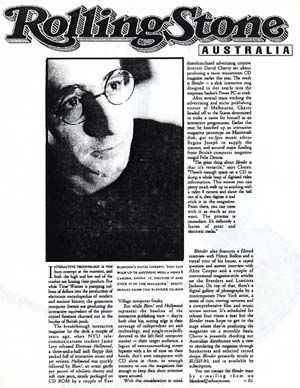
While working at J Walter Thompson's New York office, in the early days of Silicon Alley, David met Jason Pearson, and together they co-founded Blender magazine, built a prototype, and secured funding from British publisher Felix Dennis (infamous from Oz, Maxim, and the "Did I Mention the Free Wine?" poetry readings). Blender pioneered digital music publishing and has been included in the permanent collection of the Smithsonian and the Victoria & Albert Museums. It also produced some of the very first interactive advertising for clients including Nike, Calvin Klein, Toyota, and Apple.
In 1996, as it became clear that Blender would never be a commercial success, the interactive design and coding team formed Dennis Interactive, an interactive advertising agency. Over the next six years, clients included Mercedes Benz, Levi Strauss, Coca-Cola and Disney. The company pioneered Flash development, received many awards and was profiled in Communication Arts and on Design Interact. After four years as Technical Director and partner, David became General Manager in 2000. And then the Dot Com bust happened, followed by all the other interesting complications of living in lower Manhattan in the early 21st Century. Felix closed the company in 2002, and the dispersed talent of the agency spawned at least a dozen independent digital shops.
Since Dennis Interactive closed, David has held a range of positions - initially at independent digital agencies, and more recently taking on the task of "digitizing" larger, holding-company-owned, traditional and pharmaceutical marketing agencies:
2003-2006
Director (Production & Multimedia), managing accounts including Crown Royal Whisky, and developing rich media and interactive marketing campaigns for clients including Disney and AMC.
2006-2007
Director of Technology and Project Management, developing sites for Novartis, BET, Medtronic, Meda, Amerifit, and MedPointe, as well as emails, banners, and SEO/SEM for Eli Lilly, Genentech, and Cytyc.
2007-2008
VP, Marketing Technology, working to introduce digital media across the client base, including Social Media campaigns for CitiBank, HP, and Johnnie Walker, developed best practices around email for Nationwide and Microsoft, defined the approach to the redesign of the Wunderman corporate website, and playing a role in new business wins with EMI, Activision, and LandRover.
2009-2018
Chief Digital Officer and Chief Experience Officer for this storied healthcare agency, working with pharmaceutical clients including Pfizer, Genentech, GSK, Bayer, J&J, Ferring, BI, Shire, and Astellas to deliver digital experiences at conferences, on iPads, online, and through the full digital media ecosystem. Developed partnerships across WPP in addition to companies including Apple, Google, FaceBook, Twitter, IBM, Acquia, Veeva, DMD, and many other vendors.
2018-2019
David spent 2018-19 as Digital Lead at Brick City Greenhouse, working virtually to launch high profile oncology and opthalmology products, and building a new site for Medicines Development for Global Health, amongst other projects.
2019-
Since July 2019, David has been EVP, Director of Customer Experience at Biolumina, an agency exclusively focused on promoting oncology products for our clients. In this role, his responsibilities include Experience Planning, User Experience, and Development, working for large clients including AstraZeneca, Pfizer, and Novartis, as well as exciting new therapies from smaller companies including Exelixis, Fergene, and Arcus Biotech. As a pro bono project, Biolumina has launched a campaign against gun violence at The American Plague, with all proceeds benefitting AFFIRM Research.
David's speaking engagements have included discussing “Rapid Development of Multimedia” at the 1997 Macromedia Users Conference, "Search Engine Optimization for Rich Media Websites" at the first Digital Pharma East conference in 2007, and introducing the 12.9" iPad Pro for Apple at their NYC showroom in 2015.
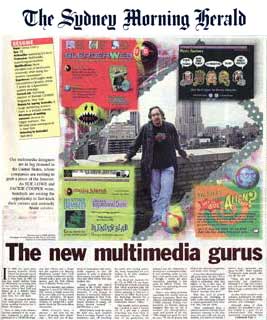
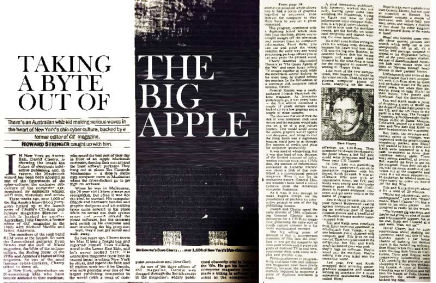
Over the years he has been interviewed by publications including the New York Times, Sydney Morning Herald, The Age, Rolling Stone, and the New York Post, as well as on film, TV, radio, and the Internet on various aspects of the “digital revolution”.